
Blog
What Is Peptide Reconstitution?

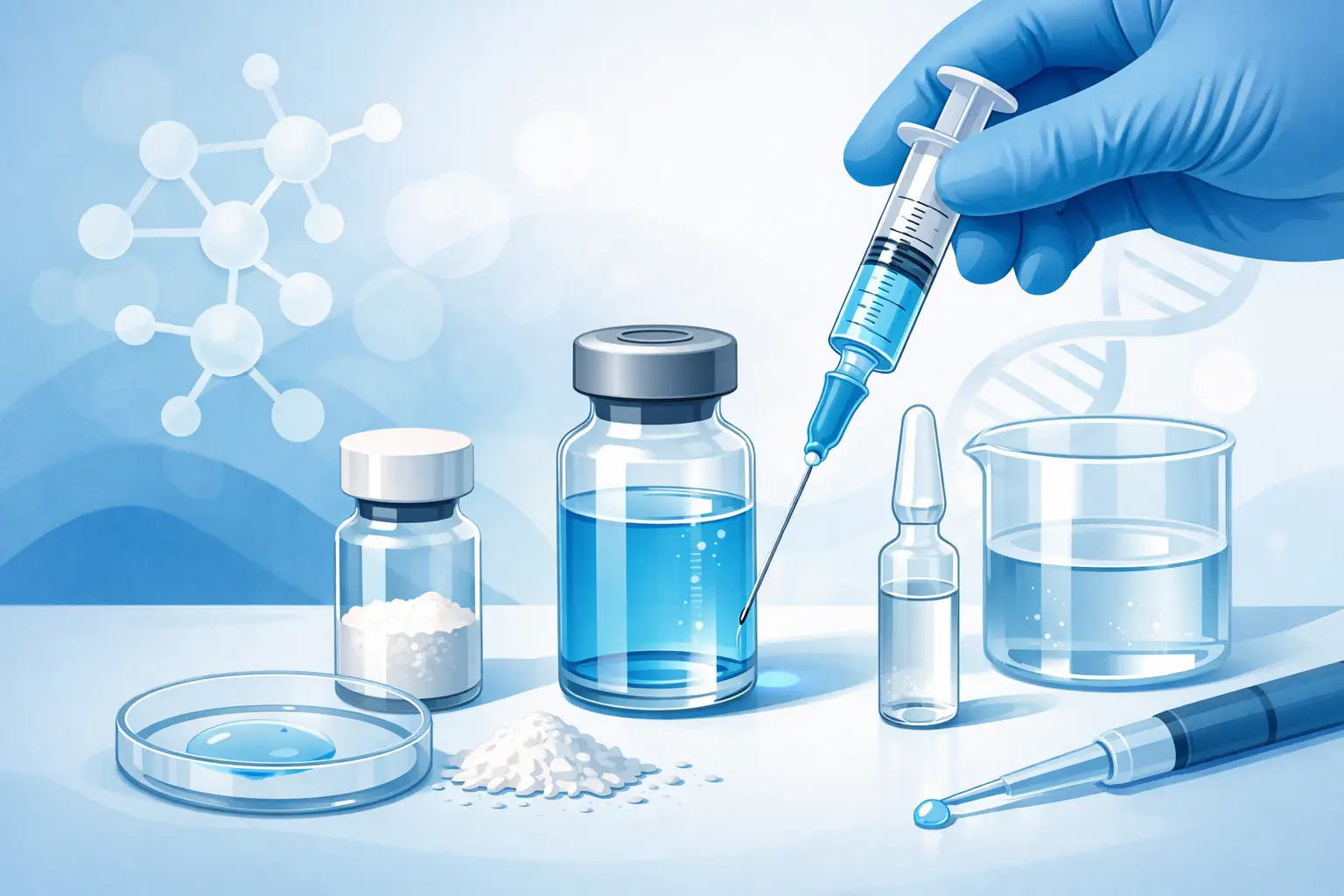
A vial arrives lyophilized, the certificate checks out, purity looks right, and the next question is practical: what is peptide reconstitution, and why does it matter so much to downstream research quality? In simple terms, peptide reconstitution is the process of dissolving a dried peptide powder into a chosen liquid solvent to create a usable research solution. It sounds routine, but this step sits directly between verified material quality and reliable experimental handling.
For research buyers, reconstitution is not a minor prep detail. It affects concentration accuracy, peptide stability, storage behavior, and day-to-day reproducibility. A high-purity peptide can still become a poor research tool if it is reconstituted with the wrong solvent, mixed too aggressively, exposed to contamination, or stored under unsuitable conditions.
What is peptide reconstitution in practical terms?
Most research peptides are supplied in lyophilized form, which means the compound has been freeze-dried into a stable powder. This format is widely used because it generally supports transport, handling, and longer-term storage better than pre-mixed liquid solutions. Reconstitution begins when the researcher adds a measured volume of solvent to that powder so the peptide can be brought into solution at a defined concentration.
That concentration matters. If a lab needs a peptide at 2 mg/mL or 5 mg/mL for a protocol, the reconstitution step is where that working concentration is established. A small measuring error at this stage can carry through an entire experiment, especially in studies where dosing precision or repeatability is critical.
The term itself can create confusion because it suggests restoring something to its original state. In laboratory use, it is more precise to think of reconstitution as controlled dissolution. The goal is not just to make the powder disappear into liquid. The goal is to create a chemically suitable, stable, and accurately measured research solution.
Why reconstitution matters beyond simple mixing
Peptides are not all alike in how they behave once solvent is introduced. Sequence, chain length, charge distribution, hydrophobicity, and formulation conditions can all influence solubility. Some peptides dissolve readily in sterile water or bacteriostatic water. Others may require an initial small volume of acidic solution or another compatible solvent before dilution to the final target concentration.
This is where many handling problems begin. A peptide that appears cloudy, forms visible particulates, or resists full dissolution may not be reacting well to the chosen solvent or concentration. In some cases, the issue is not product quality but mismatch between peptide chemistry and reconstitution conditions.
From a research operations perspective, proper reconstitution also supports batch consistency. Labs that source high-purity compounds with verified analytical documentation still need disciplined handling after receipt. If one technician reconstitutes slowly with cold solvent and another vortexes aggressively with a different liquid, the variability introduced is operational, not analytical. That distinction matters when data quality is under review.
The role of solvent selection
Solvent choice is one of the most important variables in peptide reconstitution. There is no single universal liquid that works best for every peptide. Water-based solvents are common, but the best option depends on the compound’s characteristics and the intended research workflow.
Sterile water is often considered first because it is simple and broadly compatible. Bacteriostatic water may be used in some research settings where repeated vial access is relevant, though preservative content can affect suitability depending on the compound and protocol. Some peptides with lower water solubility may first require a small amount of acetic acid solution or another appropriate solvent system before being diluted further.
The trade-off is straightforward. A stronger or more specialized solvent may improve solubility, but it can also alter pH, affect stability, or introduce variables that matter later in the research process. That is why experienced buyers look beyond basic product selection and consider handling requirements as part of the total use profile.
Concentration is not just math
On paper, reconstitution looks simple: divide the amount of peptide by the volume of solvent added. In practice, concentration planning should begin before the solvent touches the vial. Researchers usually work backward from the intended study design, required aliquot size, storage plan, and expected use window.
A highly concentrated solution may save freezer space and reduce repeated vial manipulation, but some peptides become harder to dissolve or less stable at higher concentrations. A more diluted solution may be easier to handle, yet it can create larger storage volume, increase freeze-thaw exposure, or shorten useful life after reconstitution.
This is one of those areas where it depends. The right concentration is the one that supports the protocol without creating avoidable solubility or stability problems. Precision-driven labs treat this as a planning step, not an afterthought.
Handling technique affects solution quality
Even when the solvent and target concentration are well chosen, physical handling still matters. Gentle addition of solvent along the vial wall is often preferred over forceful injection directly onto the peptide cake. After solvent addition, many researchers allow the vial to sit briefly so the material hydrates before mixing.
Aggressive shaking is usually not ideal. Some peptides respond better to gentle swirling or slow inversion. Excessive mechanical force can increase foaming or create the impression of incomplete dissolution when the issue is really air incorporation. In temperature-sensitive contexts, researchers may also allow the vial to equilibrate appropriately rather than forcing rapid dissolution.
None of this is dramatic, but precision work rarely is. Reliable results are often protected by small handling decisions made consistently.
What can go wrong during peptide reconstitution?
The most common issues are incomplete dissolution, concentration miscalculation, contamination, and stability loss. Sometimes the peptide clings to the vial or appears cloudy because the solvent system is suboptimal. Sometimes the math is correct but the actual delivered volume is off due to imprecise pipetting. Sometimes a peptide dissolves fully, yet repeated room-temperature exposure reduces its integrity over time.
There is also the issue of assuming all lyophilized powders behave the same way. They do not. Formulation residues, vial size, fill weight, and peptide-specific chemistry can all influence how reconstitution proceeds. That is why high-level sourcing and high-level handling belong together. Third-party verification confirms what arrived. Proper reconstitution helps preserve what was verified.
Storage after reconstitution
Once a peptide is in solution, storage conditions typically become more restrictive than they were in the lyophilized state. Many reconstituted peptides are more vulnerable to degradation from temperature shifts, repeated freeze-thaw cycles, light exposure, or prolonged storage in liquid form. Exact conditions depend on the peptide and the research context, but the broad principle is consistent: solution state usually requires more discipline than powder state.
Aliquoting is often used to reduce repeated vial access and minimize freeze-thaw cycling. This can improve handling consistency, especially in labs running repeated studies over time. The trade-off is additional preparation complexity and greater demand for careful labeling, dating, and inventory control.
For serious research environments, storage planning should begin at the time of purchase. Fast fulfillment and dependable batch documentation matter, but so does having a clear plan for how the compound will be reconstituted, portioned, and stored once it reaches the lab.
Why sourcing quality still matters here
A clear answer to what is peptide reconstitution is only half the picture. The other half is knowing that the material being reconstituted is what it claims to be, at the purity level stated, with documentation that supports research confidence. Reconstitution cannot correct poor sourcing. It cannot fix contamination, weak analytical transparency, or inconsistent batch quality.
That is why research buyers tend to evaluate peptide suppliers through a wider lens. Purity thresholds, batch-level COA access, HPLC or MS documentation, and contaminant screening all shape the starting point. When those controls are strong, reconstitution becomes a matter of careful laboratory execution rather than guesswork about the underlying material.
For buyers operating on compressed timelines, this matters operationally as much as scientifically. A delayed shipment or an undocumented batch can stall a study before reconstitution even begins. A verified, research-focused supply partner reduces those avoidable variables.
A better way to think about peptide reconstitution
Peptide reconstitution is best understood as a control point. It is where material quality, concentration accuracy, solvent compatibility, and storage strategy converge. Labs that treat it as a routine step often discover preventable variability later. Labs that treat it as part of the analytical chain usually protect cleaner handling and stronger reproducibility.
That mindset fits the broader standard serious research now demands. Precision does not start at the assay. It starts when the vial is selected, documented, reconstituted, and prepared for use with the same level of discipline applied to every other part of the workflow.
For researchers sourcing premium compounds from suppliers such as Peptora Peptides, that is the practical advantage of combining verified quality with exact handling: better control at the bench, and fewer questions when the data starts to matter.
