
Blog
Lyophilized Peptides vs. Solutions: 5 Superior Factors for Lab Results

A peptide arrives on schedule, the COA looks clean, and the assay meets spec. Then the practical question shows up: should your lab source lyophilized material or a pre-made solution? That is where lyophilized peptides vs solutions becomes less of a product preference and more of a research operations decision.
For experienced buyers, this choice affects more than convenience. It shapes storage planning, shipping risk, reconstitution control, batch handling, and how much confidence you can carry from receipt through use. The right format depends on the compound, the timeline, and the level of control your workflow requires.
Lyophilized peptides vs solutions: what changes in practice
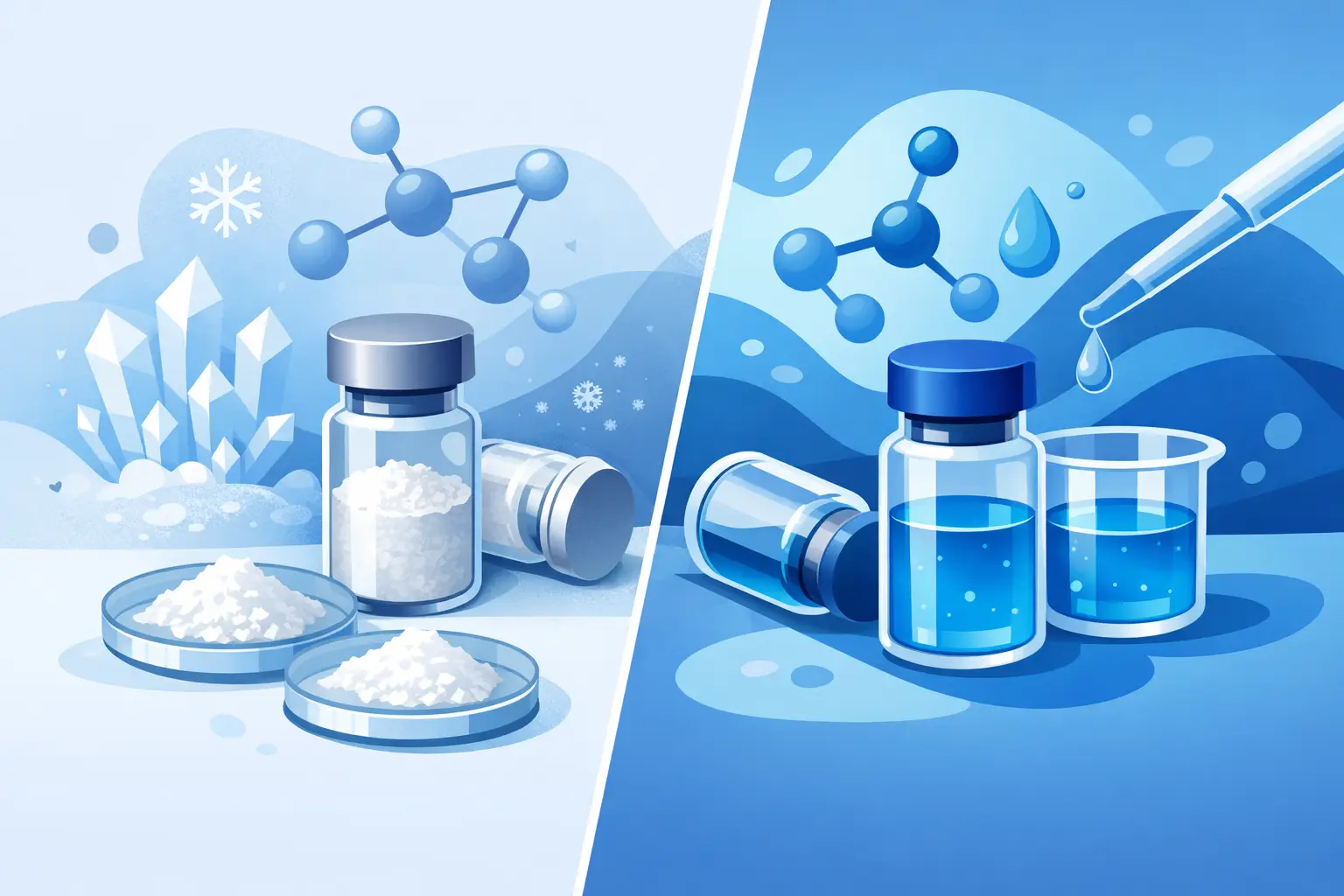
At the chemistry level, the peptide sequence is the same target analyte. What changes is the presentation. Lyophilized peptides are supplied as a dry powder after freeze-drying, while solutions are supplied already dissolved in a chosen solvent system.
That distinction matters because dry-state presentation often supports stronger long-term stability assumptions when handled correctly. A solution, by contrast, trades some of that stability margin for immediate usability. For labs moving quickly, that trade can be worthwhile. For labs storing inventory across multiple projects, it often deserves closer scrutiny.
The decision is rarely universal. One team may prioritize rapid deployment and standardized prep time. Another may care more about extending shelf life, minimizing degradation risk during transit, or choosing its own reconstitution conditions. Serious sourcing starts by matching format to actual laboratory conditions rather than defaulting to whichever option looks simpler.
Why many research buyers prefer lyophilized format
Lyophilized peptides are often favored because they preserve optionality. A dry vial typically gives the researcher more control over solvent selection, concentration, aliquoting strategy, and handling conditions. That can be especially valuable when a protocol is sensitive to pH, excipient profile, or repeated freeze-thaw exposure.
Shipping is another major factor. Dry material generally tolerates transit stress better than a prepared liquid, assuming packaging and temperature controls are handled appropriately. A solution may be more vulnerable to thermal excursions, container interaction, or time-in-solution degradation before it even reaches the bench. For buyers who have dealt with delayed delivery windows or seasonal temperature variability, that distinction is not theoretical.
Inventory management also tends to be cleaner with lyophilized stock. Labs can receive a batch, verify documentation, and hold it under defined storage conditions until needed. Reconstitution happens closer to the point of use, which reduces the time the peptide spends in a potentially less stable liquid state.
None of this means lyophilized is automatically better. It means the format provides tighter control when your team has the capability and discipline to manage reconstitution correctly.
Reconstitution control is a real advantage
With lyophilized material, the lab determines how the peptide enters solution. That gives researchers discretion over solvent compatibility, target concentration, and aliquot size. If your protocol demands a narrow concentration range or if your solvent choice must align with downstream analytical conditions, this flexibility matters.
It also reduces dependence on a supplier’s default formulation choices. In some cases, a ready-made solution may include a solvent system that works for general handling but is not ideal for your assay design or storage plan. Dry format avoids that mismatch.
Stability planning tends to be stronger
Many peptide buyers think first about purity at release, which is valid. But post-purchase stability is where avoidable losses often happen. Lyophilized presentation can reduce degradation exposure before first use, particularly for compounds sensitive to hydrolysis or prolonged liquid-phase storage.
That does not eliminate degradation risk. It shifts when and how that risk is managed. A disciplined lab can often control that phase more effectively than a shipping network can.
When solutions make more sense
Pre-made peptide solutions have a place, and for some workflows they are the better operational fit. If a lab needs immediate readiness, minimal prep variability, or standardized handling across multiple users, solutions can reduce friction.
This is especially relevant in high-throughput environments or short-window studies where prep time is a bottleneck. A qualified solution can simplify deployment, reduce reconstitution error, and improve day-to-day consistency when multiple operators are involved.
Solutions may also help when working with very small quantities where reconstitution losses become a concern. Handling a dry powder requires precision, and not every setting benefits from introducing another preparation step.
The trade-off is that convenience narrows flexibility. The solvent system is already chosen. The concentration is already set. The clock on in-solution stability has already started. If those constraints align with your method, a solution can be efficient. If they do not, the convenience can become a limitation.
Lyophilized peptides vs solutions for shipping and storage
For U.S.-based research buyers, logistics can be as important as formulation. A premium peptide with weak transit resilience is still a supply risk. This is where the comparison between lyophilized peptides vs solutions becomes highly practical.
Lyophilized products are generally better suited for variable shipping conditions because they are not already in a solvent environment that may accelerate degradation. They also tend to support longer storage windows when held according to specification. That can make them more forgiving for labs ordering ahead, consolidating inventory, or managing irregular usage schedules.
Solutions demand tighter alignment between supplier handling, shipping speed, and receiving protocol. If a solution spends too long in unfavorable conditions, the margin for quality retention may narrow before the package is even opened. That is why fulfillment speed, packaging discipline, and documentation standards matter more with liquid presentations.
For serious buyers, format should never be evaluated separately from supplier capability. Batch verification, third-party testing, clear COA access, and dependable fulfillment are not marketing extras. They are part of the risk profile.
Documentation matters more with solutions
Every peptide purchase should come with meaningful analytical support, but solutions raise additional questions. With a lyophilized vial, the core focus is typically identity, purity, and batch consistency. With a solution, buyers should also understand concentration accuracy, solvent composition, storage guidance, and any formulation-specific considerations that affect research use.
This is where transparent documentation separates professional suppliers from commodity sellers. A serious research operation should not be guessing about what is in the vial beyond the peptide itself. The more finished the presentation, the more important the formulation details become.
Labs sourcing from vendors such as Peptora Peptides often look for that transparency because it shortens qualification time. Clean batch-level documentation does not just build trust. It supports faster internal decisions and fewer disruptions once material reaches the lab.
How to choose the right format for your workflow
Start with the timeline. If you expect near-immediate use and need standardized prep across operators, a solution may fit. If your inventory may sit before use or your protocol requires custom reconstitution, lyophilized material usually offers better control.
Then look at the peptide itself. Some compounds are less forgiving in solution, while others may be manageable if stored and used within a narrow operational window. Your method, not generic preference, should guide the decision.
Next, examine your internal handling discipline. A lab that can reconstitute accurately, aliquot cleanly, and maintain storage controls can capture the benefits of lyophilized format. If that discipline is inconsistent, a validated solution may reduce operator-dependent variation.
Finally, evaluate the supplier as part of the format decision. Fast shipping, batch verification, transparent COA and analytical data, and research-use-only clarity are all part of the purchasing equation. Format choice without supplier quality control is incomplete.
The real question is control versus convenience
Most comparisons between lyophilized and solution peptides are framed too simply. The issue is not which format is superior in the abstract. The issue is where your lab wants control, and where it prefers convenience.
Lyophilized peptides usually give the buyer more control over stability management, concentration setup, and storage strategy. Solutions reduce handling steps and can accelerate execution. Both can serve serious research. The stronger choice is the one that fits your protocol, logistics, and quality expectations without introducing avoidable uncertainty.
If your work depends on consistency, treat presentation format as part of your quality system rather than an afterthought. A well-sourced peptide starts with purity, but reliable research depends on what happens after the vial arrives.
