
Blog
How to Verify Peptide Purity: Avoiding Research Risks

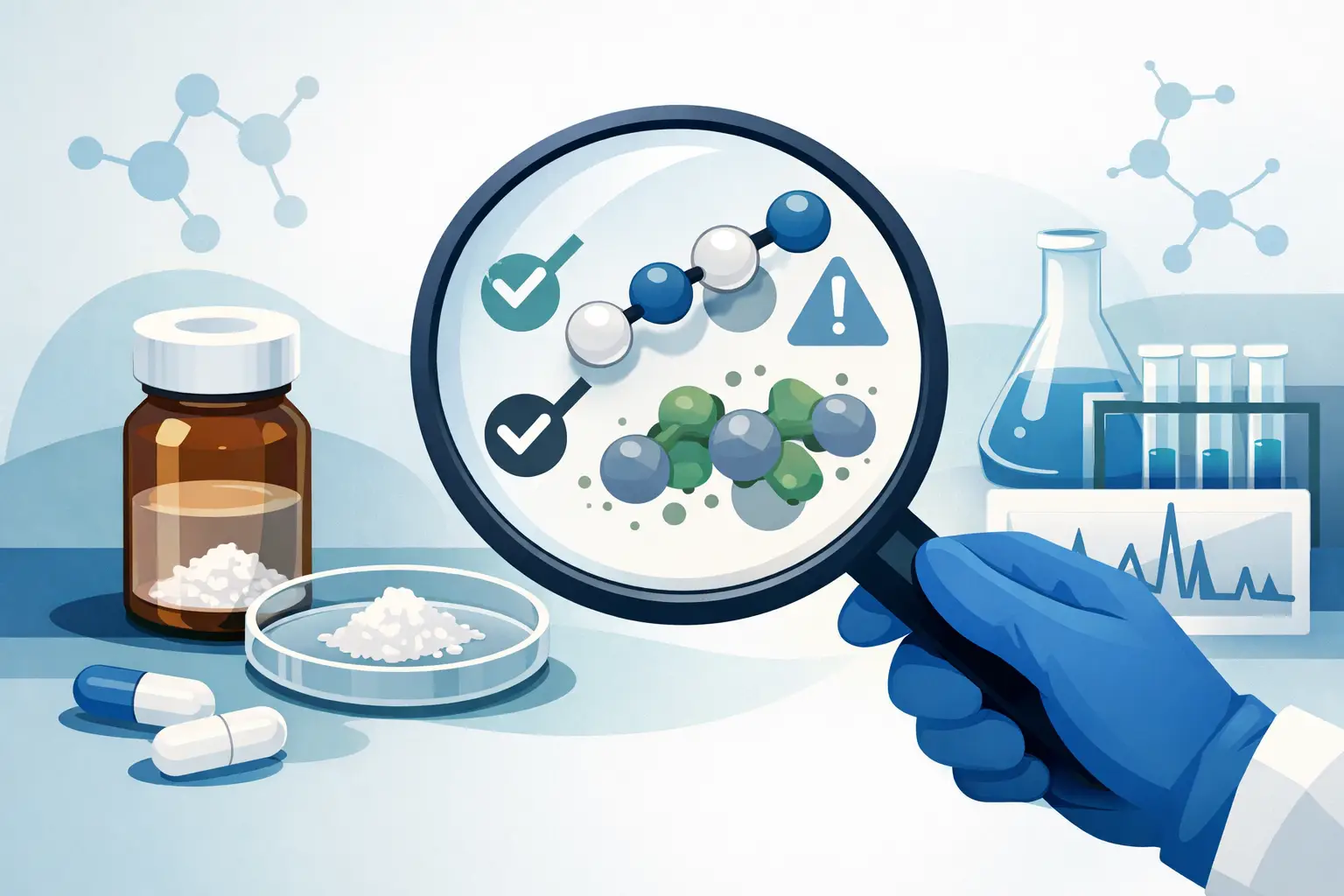
A peptide labeled 99% pure can still be the wrong fit for serious research if the documentation behind that claim is thin, outdated, or disconnected from the actual batch in hand. If you want to know how to verify peptide purity, the real task is not reading a number on a product page. It is evaluating the analytical evidence, the testing context, and the premium peptide sourcing standards that a supplier applies with the same discipline you use inside the lab.
For research buyers, purity is not just a marketing spec. It affects reproducibility, signal clarity, downstream interpretation, and whether a project moves forward on schedule or stalls because the material introduces avoidable uncertainty. A credible purity claim should be traceable, batch-specific, and supported by methods that make sense for the compound being purchased.
What peptide purity actually tells you
Peptide purity usually refers to the percentage of the target peptide relative to detectable impurities within the analytical method used, most often HPLC. That sounds straightforward, but the number only means something when you know how it was generated. A 99% HPLC purity result indicates that the chromatographic profile is dominated by the target peak, yet it does not automatically confirm identity, exclude every contaminant, or guarantee equal stability across handling conditions.
This is where buyers can get misled. A high purity value may still sit alongside problems such as residual synthesis byproducts, degradation products, salt content variation, moisture differences, or incomplete characterization. Purity is a critical quality signal, but it is one signal among several. The right question is less “What number is printed?” and more “What evidence supports this batch, and what does that evidence leave unresolved?”
How to verify peptide purity from supplier documentation
The fastest way to assess a peptide supplier is to examine whether its documentation is built for scrutiny or built for appearance. Serious suppliers provide batch-level records that can be checked, not generic files meant to reassure at a glance.
Start with the certificate of analysis. A useful COA should identify the specific batch or lot number, the peptide name, the test methods used, and the reported results. If the COA is missing batch identifiers, dates, or method references, it becomes difficult to connect the document to the material being ordered. That gap matters because even a strong historical result does not verify a different production lot.
Next, look at whether the COA aligns with the product listing and supporting analytical files. The reported purity should match the chromatogram and mass spectrometry data provided for that same batch. If the site shows one purity figure, the COA shows another, and the attached chromatogram appears generic or unlabeled, confidence drops fast. Documentation should tell one coherent story.
A disciplined supplier will also make testing transparency easy to evaluate. That includes third-party verification, clear reporting conventions, and enough analytical detail for a research buyer to judge whether the result is credible. At Peptora Peptides, that standard is central because serious research sourcing depends on traceable, batch-specific proof rather than broad quality claims.
HPLC is the core purity check, but context matters
When buyers ask how to verify peptide purity, HPLC is usually the first place to look, and for good reason. High-performance liquid chromatography is the standard analytical tool for assessing peptide purity because it separates the target compound from related impurities and shows their relative abundance.
A clean chromatogram with a dominant main peak is a positive sign, but it still requires interpretation. You want to know whether the chromatogram is labeled with retention time, whether impurity peaks are visible, and whether the integration appears credible rather than artificially simplified. An unreadable image or stripped-down report is not the same as meaningful transparency.
Method conditions also matter more than many buyers realize. Different columns, solvents, gradients, and detection wavelengths can affect how impurities appear. That means purity numbers are comparable only within reason. One supplier’s 99% claim may not be analytically identical to another’s if the methods differ significantly. For procurement decisions, consistency within the supplier’s own testing framework is often more useful than chasing the highest advertised number across unrelated methods.
There is also a practical trade-off. Very high purity is desirable, but if the supplier cannot show repeatable batch consistency, the purity spec alone loses value. Labs do not buy a single data point. They buy a supply relationship that supports reliable experimental execution.
Why mass spectrometry matters for identity
HPLC tells you how clean the sample appears under the chromatographic method. It does not, by itself, confirm that the main peak is the correct peptide. That is where mass spectrometry becomes essential.
Mass spec helps verify molecular weight and supports identity confirmation. If a peptide’s expected mass is not reflected in the analytical result, a high HPLC purity figure becomes much less meaningful. The sample may be clean relative to detectable impurities yet still not be the intended compound. For research buyers working under timeline pressure, identity failure is often more damaging than a slightly lower but honestly documented purity result.
The strongest documentation pairs HPLC with MS because the two methods answer different questions. One addresses relative purity. The other helps confirm molecular identity. Together, they create a much more defensible quality picture.
Batch verification is where trust becomes operational
A common sourcing mistake is treating peptide quality as a supplier-level trait instead of a batch-level trait. Reputable vendors may have strong systems, but research results depend on the actual lot shipped to your lab. That is why batch verification matters so much.
If you are reviewing a supplier, check whether the COA, chromatogram, and MS data are tied to the exact batch available for purchase. Ask whether each production lot is tested or whether results are carried forward from representative runs. The latter may be acceptable for some materials in some contexts, but it should be disclosed. For high-confidence research procurement, current batch-specific verification is the stronger standard.
This is especially relevant for labs trying to maintain continuity across repeat orders. Even small shifts in impurity profile or handling quality can complicate longitudinal work. A supplier that supports batch traceability reduces that risk and makes internal quality review much easier.
Purity is not the same as overall quality
A buyer focused only on purity percentage can miss other variables that affect usability. Depending on the research context, residual solvents, endotoxin concerns, heavy metals, moisture content, storage conditions, and reconstitution behavior may all matter. Not every project requires every screen, but high-value work often justifies looking beyond the headline purity result.
This is where “it depends” applies. For some early-stage research workflows, HPLC and MS may be sufficient if the supplier’s records are current and consistent. For more sensitive applications, additional contaminant screening may be worth requiring before purchase. The goal is not maximal testing for its own sake. The goal is aligning analytical depth with research risk.
Packaging and fulfillment discipline also deserve attention. A well-documented batch can still underperform if storage, temperature exposure, or shipping handling are poorly controlled. Quality assurance is not only an analytical question. It is a chain-of-custody question.
Red flags that should slow a purchase decision
The warning signs are usually obvious once you know where to look. Generic COAs without lot numbers, blurred chromatograms, missing MS data, inconsistent purity claims across pages, and no indication of third-party testing all suggest weak verification culture. So does evasive support when basic documentation questions are raised.
Another red flag is overreliance on absolute language. Serious suppliers understand analytical limits and communicate with precision. If every product appears to carry the same ultra-high purity claim with minimal supporting data, skepticism is warranted. Real testing produces real variation, and credible vendors report it clearly.
A practical standard for research buyers
If you need a working procurement standard, keep it simple. Verify that the supplier provides a batch-specific COA, readable HPLC data, supporting MS identification, and clear alignment between the listed product and the actual lot documentation. Then consider whether your project needs added screens for contaminants, heavy metals, or other risk factors.
This approach is efficient because it separates genuine quality systems from polished presentation. It also respects a truth that experienced buyers already know: reliable research supply is built on consistency and transparency, not just attractive purity numbers.
The strongest peptide sourcing decisions come from treating documentation as part of the material itself. When the data are current, batch-linked, and analytically coherent, you are not just buying a compound. You are buying confidence that your next result reflects the research, not the source.
